Harbor Light Pavilion
Featured Projects
Parametric Pavilion Design for Milwaukee | Modeled in Grasshopper & Rhino 7

Project Overview
Conceptual Development & Technical Exploration

A. Site & Program
(A)
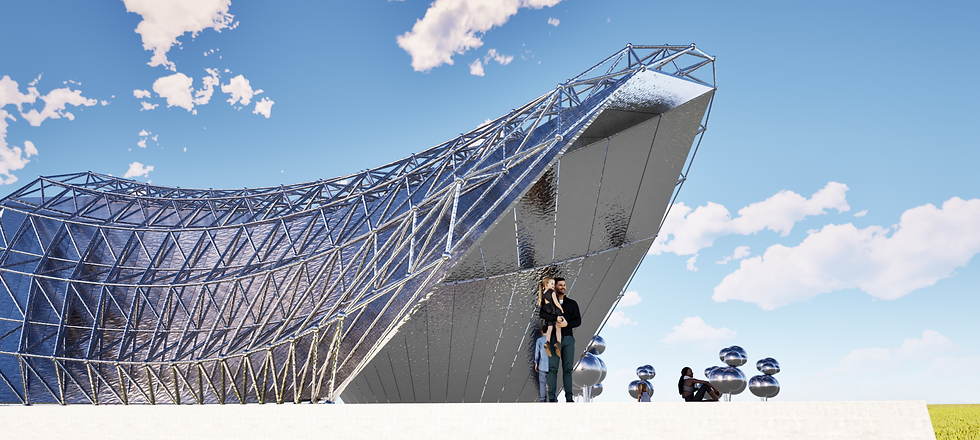
This project is a conceptual pavilion designed for Milwaukee's waterfront. The goal was to create a structure that functions as both a public pavilion and a sculptural landmark. Rather than serving only as a place for shelter, the pavilion is intended to become a destination where people can gather, interact, and experience the waterfront from a different perspective. Its open form encourages movement through the space while creating opportunities for conversation and engagement with the surrounding environment.

B. Design Concept
(B)
For this project, I wanted to create a form that felt both organic and highly structured. The design combines fluid, sweeping curves with sharp, defined edges to create a sense of movement while maintaining a strong structural presence. Inspired by futuristic and industrial aesthetics, the metallic steel framework gives the pavilion a bold, sculptural identity that feels almost otherworldly. The contrast between the smooth geometry and the angular connections creates a dynamic balance, allowing the structure to appear both lightweight and powerful. Rather than functioning solely as a pavilion, the design is intended to serve as a public art installation that invites curiosity, interaction, and conversation along Milwaukee's waterfront.

C. Process & Tools
(C)
This project was my introduction to parametric design using Rhino and Grasshopper. Instead of modeling each element individually, I created a parametric definition that allowed me to explore different forms by adjusting key design parameters. This process made it easy to test multiple iterations while maintaining the overall structural logic of the pavilion. Through this project, I strengthened my understanding of computational design and learned how parametric tools can support a more efficient and exploratory design process while producing complex forms that would be difficult to develop using traditional modeling methods.